

So you want to discover five must-know things that can help you improve your PR outreach efforts? Before you do that, let’s paint a bigger picture and look at today’s media relations landscape. Currently, there are challenges for both PR teams and journalists: On the one side the Inside PR 2026 Report reveals that 60% of PR professionals cite the volatile media landscape as their biggest hurdle; on the other side, the 2026 State of the Media Report reveals that the No. 1 challenge for journalists is accuracy and misinformation.
So, what can you do as a PR professional to overcome your own challenges, but also meet journalists halfway, while knowing that they’re dealing with their own hurdles? Before you turn to PR tarot cards to understand what journalists are thinking (although that’s something you’re welcome to try out), we thought hearing from reporters themselves might be a more practical way to go about it.
While we recommend looking at the 2026 State of the Media Report for insight into how journalists think, sometimes reading actual words from journalists themselves can have a bigger impact. That’s why we went back into the raw data to pull out write-in responses from the journalists who completed our survey.
We highlighted some of the hardest-hitting quotes that speak to the realities of modern journalism, so you can improve your PR outreach. While each of these quotes is personal to the individual journalist, we picked out the ones that represented common threads and were consistent with the larger themes and trends of the report.
1. Meet inbox expectations
Make sure your pitch is relevant to their audience, consider local or regional relevance, and research the journalist’s beat. Almost 4 in 5 said they’re most likely to engage with pitches aligned to their beat and audience. Here’s what they told us on this topic:
"Learn more about my publication before contacting me and wasting my time with irrelevant material."
“Make it timely and relevant. Make a tiny effort to Google what I've written/published before. Don't spam me; be targeted.”
“Please, please do your due diligence on where a journalist is currently contributing and what they're covering. I get far too many pitches about an outlet where I haven't written in years or a topic that I would not/could not cover. I can tell almost immediately when a PR person hasn't done 20 seconds of Googling and reviewed my site, which has a specific pitch guide to aid in their pitching.”
“Really follow what kind of stories my organization shares, not just me as an individual journalist... a lot of times we are sharing stories from our website and not personally what we have done.”
“Top Priorities: Align with my beats (do a little research rather than mass reach); connect to a strong thought-leader/angle, not just selling the voice of a vendor/seller; have a personal approach (conversational/less words).”
“Offer paid budgets along with earned. I'm happy to do favours, but my publication cannot survive without advertisements.”
2. A pitch on its own won't do
No matter how well-written and relevant your pitch, there’s no guarantee it’ll get noticed and secure you earned media coverage. When journalists open an email from a PR professional, they’re more likely to be impressed if you provide them with data or research (47%), embargoed or early access information (45%), and access to experts or interviews opportunities (42%). Here’s what makes a pitch truly stand out:
“It needs to be something they come to me with first – don't pitch me something great, then tell me you've shopped it around and are waiting to hear from others too.”
“Include audio in email (or video that sound bites can be pulled from) with permission to broadcast with appropriate credit.”
“Include high res' jpeg images of your clients’ products or mugshots of spokespeople (not generic Shutterstock images and/or company logos), plus include your client's URL so I don't have to Google it.”
“Include phone [numbers] and emails on releases and multiple contacts in the event that the lead contact is not available, especially within 48 hours of release. Ensure that a release, pitch or brief includes the city, state of the subject company organization headquarters. As "DUH!" as this sounds, critical contact and journalism basics are tossed to the wind too often in PR dispatches.”
“Feed me with accurate and trustworthy information, give me access to good sources.”
“I am a subject matter expert...and I have a broad network of other professionals who round out my expertise. I don't need or want interviews with, or quotes from, other experts.”
3. Be mindful of boundaries
In any relationship, there are certain triggers that can damage it beyond repair. According to our survey, most journalists won’t hesitate to put you on their “don’t call” list if you spam them with irrelevant pitches (72%) or if you send pitches that sound like marketing brochures (49%).
Trust can easily be broken if you provide inaccurate or unsourced information (40%), especially as our findings indicated that the top challenge for journalists is maintaining credibility as a trusted news source. Here are a few examples of PR faux pas to avoid:
“Understanding the type of content I cover before pitching me is key. For example: My current media company covers midlife women's health. PR professionals who pitch me stories/data/products/etc. about men, teens or children will quickly be blocked by me.”
“I reach out and they don’t respond OR send the same email pitch I responded to and they blow by that fact.”
“Pitches that demand further contact, a phone call, etc. in order to get any real information. These pitches come in the form of a 2-3 sentence summary. I get hundreds of pitches a week so I have to prioritize the pitches that have all the information I need to at least start writing a story.”
“Sending the same email (usually not correctly targeted in the first place) from multiple email addresses, numerous times. I am drowning in emails that aren’t targeted to my subject area at all.”
“Poor writing and poor story concepts.”
“I am forgiving and have never blocked anyone. We all have bad days.”
4. Build a genuine connection
Most journalists are open to building relationships with PR pros – but the right approach makes all the difference. When asked about the best way to initiate a connection, most journalists agreed that the best way is a surprisingly simple one: Introduce yourself over email and tell them why you want to connect.
Of course, everyone has their own preferences, so we wanted to dive deeper into other ways you can make a good first impression. Some of the most telling responses include:
- “Just send me stuff; I’m not hostile to building relationships with PR professionals, but someone doesn’t need a relationship with me to send me stuff.”
“Connect with me on LinkedIn and share and comment and like my posts.”
“Do things that aren’t work related, just be friendly.”
“Introductions at news events, such as government meetings/hearing or campaign events are the single-most effective.”
"Invite me for a coffee when you’re in my area.”
“Not to be callous, but with hundreds of pitches per week, I don’t have time to pursue professional relationships. If a PR person can help me work faster and more efficiently and help me quickly create engaging stories, then there’s a change I’ll recognize their name in my inbox and read over most of what they send.”
5. Help them help you
You’re more likely to build a strong relationship with a journalist if you provide value – in a sea of PR pros who want their stories covered, you’ll stand out if you offer to support their work. Here’s how some journalists articulated the one thing you could do better to support them:
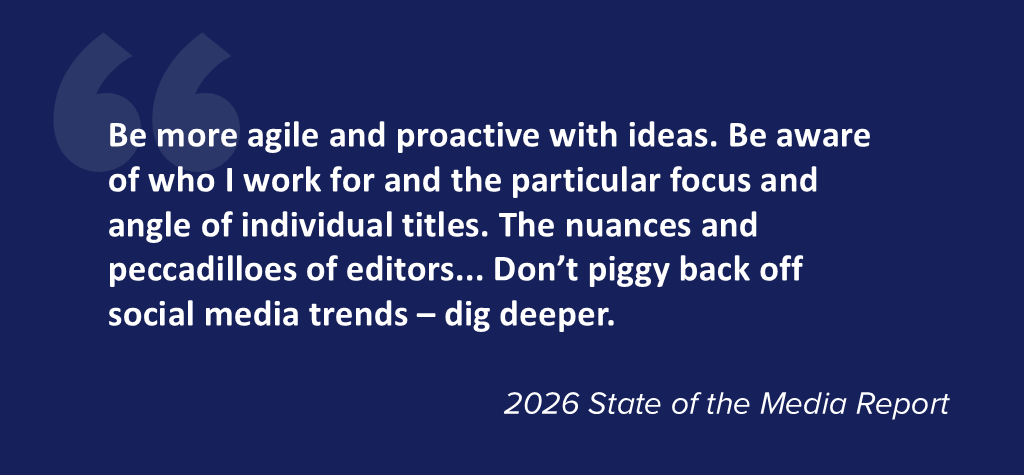
“Be prepared to give more off-the-record information or guidance and just be available to comment in a timely fashion.”
“Become educated about my audience and provide high-value, non-promotional content.”
“Come up with original, timely angles with enough time in advance for me to research and write a story.”
“Customize your pitches. I serve niche but very influential audiences, so there has to be a specific value of tips, information, inspiration or aspiration that they can actually use.”
"Understand the areas I cover. Don’t keep sending emails when I am OOO. Never phone me about a press release. Reply quickly to any query. Don’t bother with embargoes – I get too many to keep track. If I am obliged to send quotes for approval don’t turn them into marketing speak. Remember there are three things that drive the human psyche – the first two are obvious, the other is the desire to change someone else’s copy. Resist unless factually wrong.”
“Stop sounding like PR people.”
The bottom line
If there’s one key takeaway from these responses, it’s that building trust with journalists can be done by simply listening – understand their challenges, be mindful of their busy schedules, keep your promises, and give them valuable resources.
For even more insight into the journalist mindset, download the 2026 State of the Media Report, and register for our upcoming two-part webinar series Journalists Have Spoken: Making Your PR Matter in the AI Era for live, first-hand perspectives from real-life journalists.
*Editor's note: This article has been updated from an earlier version to reflect new data and findings.


