

6 Ways to Get Noticed in Journalists’ Inboxes
Imagine this: You drafted a great PR pitch, you hit send, and you wait for a reply from the journalist you sent it to. You wait and wait, but that reply never comes. So, you’re probably wondering: “Where did I go wrong?” We’ll help you find the answer to this question and give you practical advice to improve your media outreach strategy.
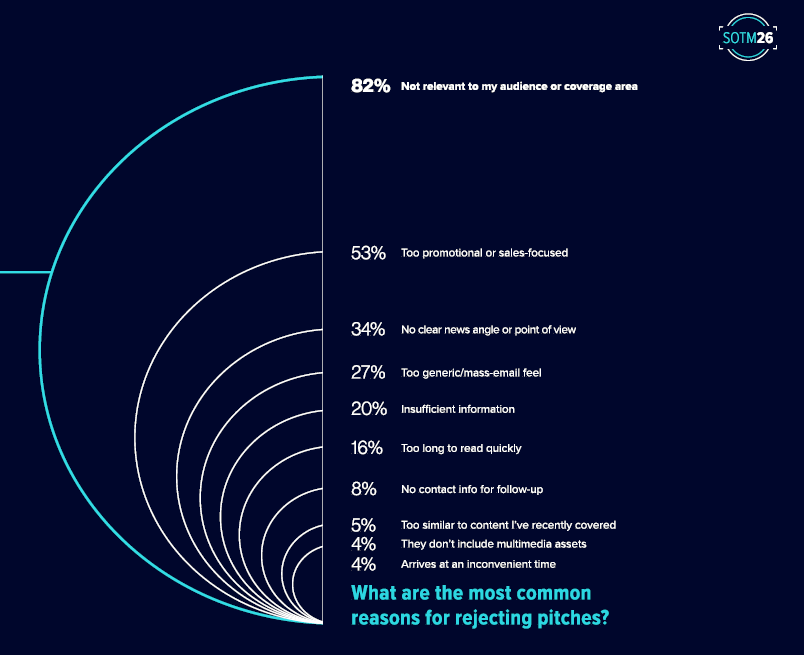
We’ll refer to the 2026 State of the Media Report, a survey of more than 1,800 journalists across different industries. According to our respondents, 4% of journalists say your pitch just arrived at an inconvenient time. And that’s a valid reason, but let’s also explore some other possibilities for why your pitches miss the mark as well as discover effective ways to create pitches journalists will want to reply to.
1. Make your pitch relevant
You might have the most intriguing story, the most relevant industry experts up for interviews, and the latest research. If it’s not relevant to the journalists’ audience or beat, it will still go to the trash folder. For 82% of reporters, relevancy is a must-have before they even consider covering a story. Not only are their inboxes overflowing with pitches (29% of them receive more than 50 pitches weekly), but only a fraction matter to them (72% of journalists find that less than a quarter of the pitches they receive are relevant). Understandably, they find receiving irrelevant pitches frustrating, and 72% of them will even go as far as blocking those PR professionals who spam them with this kind of outreach.
Your takeaway is clear: Before you pitch them, ensure you research the journalists’ outlet or beat, their audiences, and previous stories they covered. Once you pass the relevancy barrier, you’re already one step closer to securing coverage. Here’s some quickfire advice from reporters who took part in our State of the Media survey:
"Better understand the audience of the media outlets [you’re] pitching. I’ve worked for six outlets in the same market, and only two of those outlets share the same audience."
“Look at the content we publish and see if [your] pitch matches what topics we cover before spamming me with pitches.”
“Take two seconds to verify that the media you are contacting would even consider covering your pitch. Don’t send a hyper-local website news from another country."
2. Don't rely on AI to create your entire pitch
We already know PR teams are making the most of AI tools – the 2026 Inside PR Report, a survey of nearly 600 PR and comms professionals, revealed that 92% of teams use generative AI in their work. And there’s nothing wrong with that as long as you use it strategically.
Journalists place great emphasis on personalization (27% of them would delete a pitch that’s too generic or that gives a mass-email feel) and human insight. More than half (53%) of the reporters we surveyed are opposed to receiving AI-generated work. However, a quarter of them are neutral and 21% are in favor. That’s not an overwhelming “yes” or “no,” but this data suggests you need to tread carefully nevertheless.
This suggests you can use AI to help speed up the process of drafting pitches, readjust tone, or brainstorm different story angles, but don’t let your PR writing skills gather dust. Here’s some food for thought from some of our respondents:
“Any self-respecting journalist can smell an AI-written pitch a mile away. If you don’t care enough about the story to write a pitch, I will never care enough about it to write the story.”
“Customize your pitches. I serve niche but very influential audiences, so there has to be a specific value-add of tips, information, inspiration or aspiration that they can actually use.”
“Learn actual AP style, and never, ever use AI.”
3. Prioritize length, format, and style
Journalists don’t have time to read an essay-sized pitch. Sixteen percent of reporters will reject a pitch that they deem “too long to read quickly”.
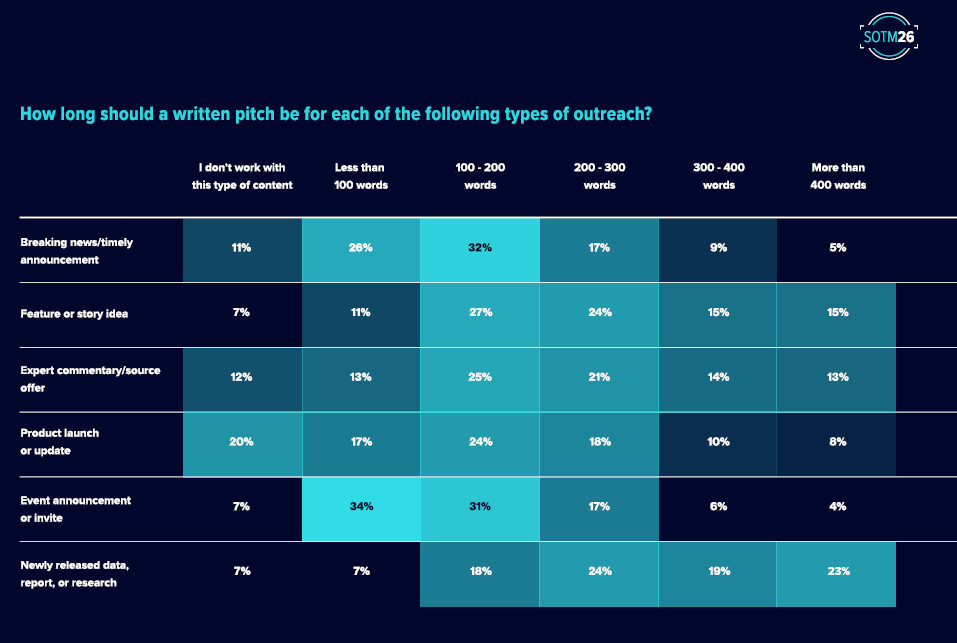
Try to craft your pitch in a way that makes it scannable, include all the relevant information, and don’t overexplain. However, while the general consensus is that pitches should be short and sweet, preferably between 100 and 200 words, keep in mind that the type of pitch also dictates its preferred length.
The secret is balance – not too short, but not too long either. Some of our respondents were straightforward about this:
“Explain quickly in pitches why something is relevant to my work and audience.”
“Keep [your] pitch brief, relevant, and with a good angle.”
“No 1-2 sentence intro/pitch emails that provide no information on the story.”
4. Supply enough extra information in your pitch
There’s no point in crafting a great subject line if your pitch doesn’t provide enough information to build out your story. Some journalists might follow up to ask for the missing pieces, but 20% of them would just move on to the next one.
Think of your pitch as the only chance to get coverage for your story – include everything that the reporter needs to know and give them access to the assets they might need to bring your story to life in one go. Here’s what journalists had to say on this:
- “Make information far more accessible. Too many companies/PR firms make it too hard to quickly track down contact details, press releases, background information, etc.; this is especially infuriating when writing for online outlets, when deadlines are tight.”
“Include a summary block with all relevant information and link to a press kit.”
“Include assets. Many times we follow up and ask... and email comes back with assets. Why wasn’t this included if you had it?”
“Provide clear, accurate, and complete information upfront – confirmed specs, real context (what’s actually new), clear embargoes, and realistic assets.”
5. Avoid making your PR pitch sound like a sales one
We know you’ve got a great story to tell about your brand, and you’re excited to share the message. But it can often sound too much like a sales pitch or advertorial. And that’s something that really ticks journalists off – more than half (53%) will reject a pitch that is too promotional or sales-focused. To top it off, 49% of reporters would put PR professionals on their “don’t call” list if they send pitches that sound like marketing brochures.
The stakes are high, so it’s best to keep your messaging clear, straightforward, and free from sales language. Here are some valuable insights from our respondents:
“Don’t send me industry materials that are written for a consumer, and don’t write ridiculously fluffy pieces talking about [how] miraculous your product is.”
“Learn how to write clearly – stop using promotional, jargon-filled, passive, opaque, bureaucratic language. Too many releases read as if a committee compiled them.”
“Learn how to write in a news style. Press releases are written in such a clichéd way.”
6. Bring a clear news angle or point of view
The art of pitching includes the ability to write it in a way that brings something new or unique, sparks interest, and leaves the reader wanting to know more. If it doesn’t capture the journalist’s attention, their audience won’t be interested either.
According to 34% of journalists, pitches with no clear news angle or point of view will be rejected. Reporters don’t want to be a promotional channel for a PR team’s client – they want a clear, newsworthy angle that makes their audience ask: “So what?” This is what journalists want from your pitch:
“[Send me] newsworthy stories and catchy, clear subject headlines.”
“Not all press releases are ‘newsworthy’. Know when you should pay to play versus assume it will get picked up.”
“PR professionals should become better writers and create better story angles.”
The bottom line
Putting time and effort into crafting a pitch, then hitting a wall of rejection is something many PR professionals have to deal with. The best way to minimize that and secure coverage is to actively listen to journalists and take into consideration what they want from you. Once you understand what make them tick and what faux pas to steer clear of, not only will you increase your chances of getting a reply, but you'll also be able to build a long-lasting relationship with them. Win their favor by offering them what the majority don’t: relevant pitches with a human tone and an appropriate length, newsworthy and unique story angles, all the information they need in one place, and no sales jargon.
The “perfect pitch” might be a myth but you can craft something close to it.
Want to improve your media outreach strategy? Our all-in-one platform CisionOne helps you create more powerful pitches and enhance your media coverage. Speak to one of our experts today.


