

In the 2026 State of the Media Report, 43% of journalists named AI as one of the biggest challenges the industry has faced in the last year (up from 30% who said the same in the 2025 report).
It’s natural for editorial teams, whose expertise lies in the written work, to be skeptical and have questions about how the technology is reshaping their industry and those they work with closely in public relations. With that in mind, we sifted through State of the Media data to get a sense of where reporters stand on the topic of AI usage in journalism (and its impact on press relations).
How do journalists use AI?
Despite reservations about the technology, journalists are leaning into generative AI to support their efforts.
Forty-eight percent are using it for brainstorming, while 43% utilize it for research purposes. A further 41% noted it helps them transcribe or summarize interview audio, and 27% use it to create content.
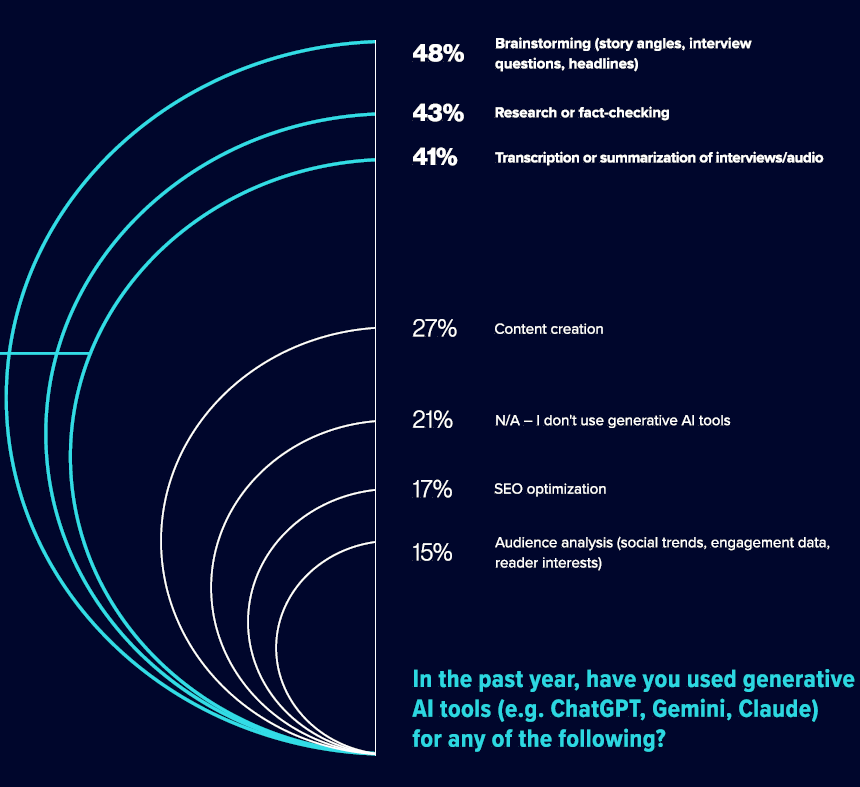
However, 21% told us they don’t use generative AI tools at all. That’s a significant shift from the responses we got in 2025, where 33% said they don’t use the technology.
Our 2026 State of the Media survey also invited journalists to tell us other ways they use AI. Their answers ranged from editing and proofing copy to workflow support. Here’s a selection of use cases named by respondents:
AI in journalism for editing and copy improvement
- An in-house toolbox for editing
- A creative catalyst for headlines
- Checking against company style guide
AI in journalism for research and information gathering
- Use of a bespoke internal LLM for research
- Guidance on finding public records
- Locating press or source contacts
AI in journalism for multimedia content creation
- Creating images for stories
- Creating visuals and memes
- Composing AI music
AI in journalism for organization and workflow
- CMS (content management system) with integrated AI features
- Use of bespoke company AI tools
- Responding to inquiries
AI and journalism: How usage differs by region
We were keen to understand the regional variations in journalists’ AI usage, so we split our survey data into North America, EMEA, and APAC segments. There were some stark differences in how journalists use AI across the globe.
North American journalists are most resistant with 36% saying they don’t use the technology, compared to only 19% in EMEA and just 6% in APAC. These echo results from our 2025 survey in terms of regional adoption, but last year nearly 1 in 2 (49%) North American journalists said they avoid using AI. This 13-percentage point shift suggests a sharp increase in adoption in 12 months, even in the most AI-resistant region.
Brainstorming is the most common use case for AI with journalists in North America, EMEA, and APAC. However, more than half of APAC journalists (54%) use AI for content creation, far more than any other region.
What do journalists think about AI in public relations?
As more PR professionals leverage AI to help produce press releases and pitches, we wanted to understand how journalists felt about being on the receiving end of this content.
The results are mixed, with 53% indicating they are opposed (either somewhat or strongly). One quarter of journalists have no strong feelings either way and 21% said they were in favor.
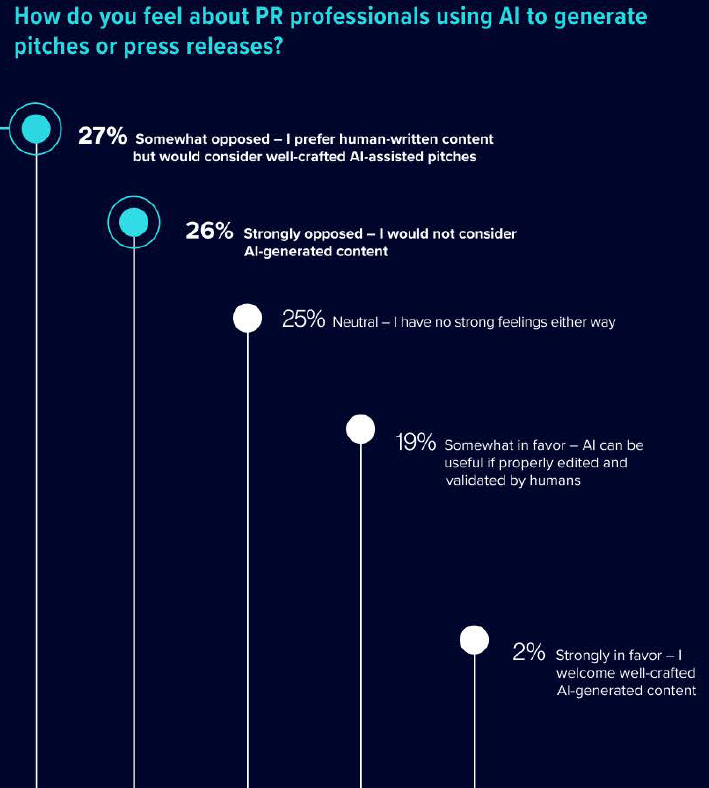
The message from journalists isn’t a blanket “no” when it comes to PRs using AI in their media outreach, but it does suggest they will be less tolerant and trusting of pitches they view as lacking a human touch.
That resistance often comes down to how easy AI-generated pitches are to spot. Mike Moore, Deputy Editor at B2B brand TechRadar Pro, noted on a Cision webinar: “It's incredibly easy to spot when someone has put zero effort in and just asked for a pitch from ChatGPT or Copilot.”
Moore says the tells range from generic, detail-heavy product announcements to pitches where his LinkedIn profile has clearly been scraped and stitched into an opening paragraph in an effort to make a personal connection.
Our survey results also saw regional variations in how journalists felt about PR professionals using AI. Unsurprisingly, given that they are the group least likely to use it themselves, 39% of journalists in North America indicated they’re strongly opposed.
On the other end of the scale, journalists in APAC – the group with the highest usage rate – are most in favor of PR professionals using AI.
3 key takeaways for PRs
AI offers many opportunities for PR and communications teams, but these findings underscore the need to be thoughtful and purposeful in using it, both in anything they create that’s public-facing and in how they communicate with journalists.
Here are three key takeaways for comms pros to keep in mind:
1. Be transparent when using AI in PR
In our 2026 State of the Media survey, 50% of reporters said accuracy, fact-checking, and combating misinformation was one of their biggest challenges. If editorial teams value this, that means their (and your) audiences do too.
Making clear when AI is playing a significant part your work should be front-of-mind for PR and comms professionals. Establishing an AI code of ethics is a good place to start here, and shows a commitment to transparency around AI research, development, and usage.
2. Use AI carefully in media outreach
While AI can help create media outreach content like a pitch or press release, the technology is far from perfect. For one, AI-generated content can be easy to spot, and knowing journalists’ resistance to AI, any outreach they see that has been wholly created by it is unlikely to be well received.
Taking time to craft and edit any AI-generated content is a must. AI has been shown to churn out inaccurate, if not completely false, information. So any time you use AI, it is critical you double-check and validate the output.
Even though AI can help speed up PR tasks at scale, personalized (and human), validated, and relevant press outreach remains essential to securing journalists’ trust.
3. Take a page out of the media’s book
While many journalists are wary of generative AI tech, they are experimenting with it – and increasingly so. They know the technology isn't going away and is constantly evolving, but they also know it is still flawed and no replacement for human expertise.
As Moore puts it, relationship-building in PR is “such an important thing but incredibly fragile,” a reminder that no AI tool should be trusted to carry it out.
Take the same approach with your use of AI and find common ground in your shared audiences. The stories both you and journalists want to tell will overlap, so consider how best to articulate them to human eyes and what role AI should play in that.
Find out how CisionOne can help you navigate the challenges and opportunities of AI in media relations.
*Editor's note: This article has been updated from an earlier version to reflect new data and findings.