

2026 State of the Media Report: Journalists open up about the hurdles they're navigating
The media landscape looks very different than it did two decades ago. Driven by the shift to online news consumption, the rise of social media platforms, and the increase in AI use, today’s journalism challenges include combating misinformation, navigating the impact of AI, and adapting to changing audience expectations.
Cision has been following this journey as far back as 2009, when our State of the Media Report began as a joint journalism survey with George Washington University to track how reporters were using a cutting-edge technology called “social media.”
A lot has changed since then. In 2009, just 56% of journalists said social media was “important” or “somewhat important” for reporting and producing stories. Today, according to the 2026 State of the Media Report, 97% of journalists are using social media for a variety or work-related purposes, from promoting stories to interacting with their audience.
Why it matters for public relations
For PR and comms professionals, understanding the current media landscape and journalists’ challenges can contribute toward building stronger relationships with the press and getting their brands’ stories shared.
What else does the State of the Media tell us about journalism in 2026? We surveyed 1,800+ reporters to find out the obstacles imposed by factors such as changing audience behaviors, maintaining trust, and the rapid growth of artificial intelligence.
We encourage you to download the full State of the Media Report, but if you’re short on time, we’ve summarized some of the findings to show what’s on journalists’ minds right now.
1. Journalists are fighting to protect their credibility
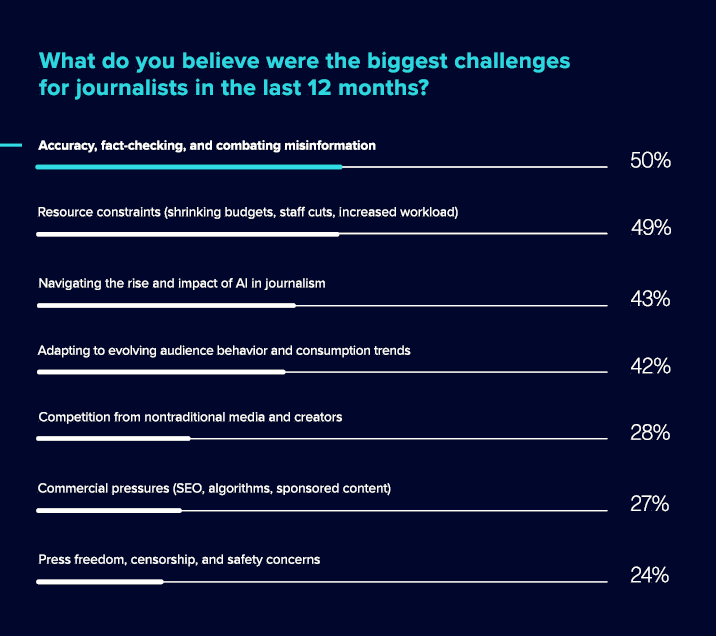
Accuracy, fact-checking, and combating misinformation are at the top of the list when it comes to journalists’ concerns in 2026, with half of reporters naming it as their biggest challenge.
This finding only goes to show that the media is under pressure from multiple directions. Misinformation continues to spread faster than newsrooms can correct it. Add to that the rise of AI-generated content. The result? It’s harder for audiences to distinguish credible reporting from fabricated or manipulated material. For journalists, this means they must spend more time verifying facts and defending their credibility than ever before.
PR takeaway: Credibility isn’t just a journalism problem; it affects PR professionals like you, too. When journalists are stretched thin verifying facts, pitches backed by clear sourcing, transparent data, and verifiable claims stand out. This approach pays off even more when it comes to AI-generated content: more than half of journalists (53%) say they’re opposed to receiving AI-generated pitches or press releases from PR, while 1 in 4 are neutral and roughly 1 in 5 (21%) are in favor.
Given this scepticism, you should carefully vet any AI-assisted work before you click send and do your due diligence to check facts and ensure accuracy. If you make a reporter’s job easier – in this case saving them time from fact-checking – rather than add to it, you’re more likely to earn their trust.
2. Newsrooms are feeling the weight of resource constraints
Shrinking budgets, staff cuts, and mounting workloads are weighing heavily on journalists in 2026, with almost half of our respondents (49%) naming resource constraints as one of their biggest challenges.
This is no surprise – there's been a wave of layoffs sweeping the industry this year. GB News is proposing to cut around one-third of its staff after developing what it calls “groundbreaking” automated workflows. The Associated Press has reduced its editorial staff by 60 people through voluntary buyouts and layoffs. The BBC plans to cut about 2,000 jobs, or roughly one in ten staff members. Other newsrooms hit by layoffs this year include The Washington Post, CBS News Radio, Politico, Future, the Wall Street Journal, Vox Media, and Bustle Digital Group.
Related to this, one of the big challenges we heard about from the journalists we surveyed was around fair compensation for their work. Here's a selection of what they told us:
- “If you demand an article or posting, please pay like you pay influencers and stop harassing media for free posting and articles if you only give product or invite us to events.”
- “Include a paid-for advertorial or advertising as part of the PR pitch. If we don't have income, they won't have a platform.”
- “Offer paid budgets along with earned. I'm happy to do favors, but my publication cannot survive without advertisements.”
PR takeaway: Journalists have less time and less tolerance for pitches that don’t respect their outlet’s financial reality. Shrinking newsrooms mean favors and free coverage carry a real cost for the publications extending them. So, what can you do? Consider where paid partnerships or advertising might complement your earned media strategy rather than relying on it entirely. Respect the journalists’ time and their publication’s bottom line to build a long-lasting relationship, not just a one-off placement.
3. AI and the existential challenges for journalism
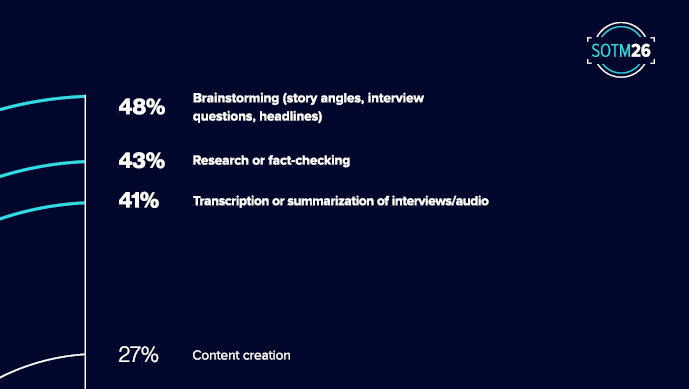
The media has a love-hate relationship with AI: its potential benefits vs. the impact it could have on their jobs. This year, 43% of journalists named navigating the rise and impact of AI as their No. 3 challenge. However, they are using it in their day-to-day work. Nearly half (48%) use AI for brainstorming, 43% for research or fact-checking, 41% for transcription or summarization of interviews and audio, and 27% for content creation.
It’s interesting to note that journalists’ feelings about AI differ significantly by region. North American journalists remain the most resistant, with more than 1 in 3 (down from 49% last year) saying they don't use AI at all. By comparison, only 30% of journalists in EMEA say the same, and in APAC, that figure drops to just 11%.
PR takeaway: Creativity and authenticity remain the pillars of journalism, and AI can’t replace journalists’ subject matter knowledge. Keep this in mind when sending AI-generated content and make sure anything they receive has gone through the human filter first.
4. Journalists are racing to keep up with (shifting) audience behavior
Adapting to evolving audience behavior and consumption trends remains a persistent challenge in 2026, with 42% of journalists naming it among their biggest concerns.
This means that the media environment continues to fragment. Audiences are discovering news through a broader mix of channels, and journalists are responding accordingly. Besides their primary newsroom, many are turning to newsletters, podcasts, webinars, and subscription-based platforms like Substack.
PR takeaway: Many of these journalism challenges will strike a chord with PR. After all, like journalists, comms teams are in the business of creating and distributing content. It's not enough to understand who your audience is, you need to know where they are, and increasingly, that includes newsletters or podcasts alongside traditional outlets. The better you are at pinpointing this, the more chance you have of helping a journalist tell a story that's relevant to their audience.
5. Social media is getting more competitive
Another emerging concern for journalists in 2026 is competition from nontraditional media and creators, cited by 28% of our respondents.
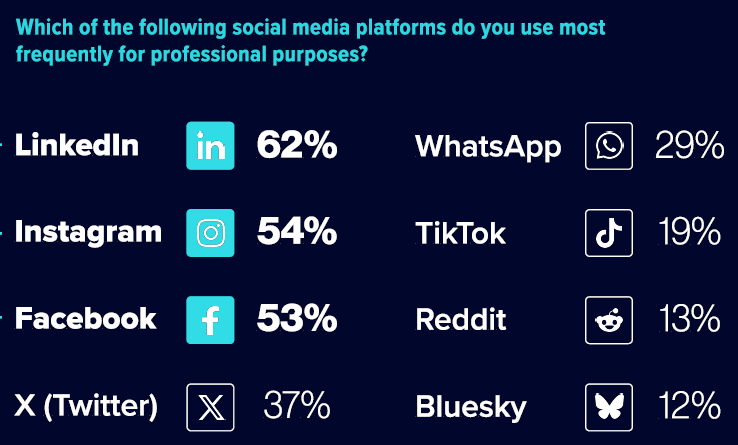
Where does this shift happen? Mainly on social media. This is where journalists increasingly compete with independent creators and influencers who now build (and monetize) audiences of their own. LinkedIn remains the top social platform used by reporters professionally, cited by 62% of respondents, followed by Instagram (54%), Facebook (53%), X/Twitter (37%), and YouTube (35%). Bluesky, meanwhile, has cooled somewhat since its early momentum, now used by 12% of journalists, down from 18% last year.
PR takeway: Journalists use social media to look for story ideas and find sources. Follow the journalists you want to connect with to understand how they work and what matters to them and their audience. Amplify their stories through your own feeds and be ready to offer relevant resources when the opportunity is right.
The bottom line
These journalism challenges are only one element of this year's State of the Media Report. One thing we’ve learned over the years is that reporters and PR professionals are increasingly operating in a fast-moving environment, both in terms of news cycles and emerging technologies that affect their day-to-day work.
They depend on each other to do their jobs effectively, and it’s evident that many of these journalistic concerns are the same for PR professionals. Journalism survey data from resources like the State of the Media can help highlight these pain paints and demonstrate opportunities for PR professionals and journalists to work together to produce trusted, credible content that their audiences will find value in.
For more findings on the biggest journalism challenges, download the full 2026 State of the Media Report.
Find out how CisionOne Outreach can help you connect you with the right journalists to share your stories, speak with one of our experts.
*Editor's note: This article has been updated from an earlier version to reflect new data and findings.