
.png)
Turn data overload into strategic decision-making.
Drowning in dashboards and still struggling to prove impact? You’re not alone – 2 in 5 PR teams struggle to convert data into actionable insight, according to our most recent Comms report.
PR teams have more data at their disposal than ever – media monitoring dashboards, social analytics, website metrics, and brand trackers all competing for attention. Yet when time comes to report results, many communicators still feel unsure which numbers truly matter or how to tell a clear story with them.
The problem isn’t a lack of data – often, it’s a lack of focus: Understanding the metrics that matter the most, depending on the story you want to tell. When you try to track everything, you dilute your message and make it harder for stakeholders to see the value of your work. The key is to start with your goal and then choose a small set of metrics that directly support it.
Based on findings from the Inside PR 2026 Report, we’ve identified three priority areas for PR teams this year:
1. Brand awareness
2. Driving sales/revenue
3. Brand reputation
We’ve broken down each of these priorities by goal and identified a select number of specific metrics to track so you can stay focused on what matters most. Use this guide to sharpen the way you track, report, and connect your work to larger business needs.
Goal: Elevate brand awareness
What you’re trying to do: Increase how often and how visibly your brand shows up in front of the right audiences.
If you only track one thing: Look at share of voice (SoV) over time versus your top competitors.
Priority metric #1: Share of voice
- What it is: Your brand’s mentions compared to key competitors across media channels.
- How to get it: Use your media monitoring platform to pull monthly trends for you and three to five primary competitors.
- How to read it: Look for sustained gains, not just one-off spikes. Annotate major campaigns so you can connect SoV changes to specific PR efforts.
Priority metric #2: Media impressions
- What it is: The estimated number of times your coverage could have been seen.
- How to get it: Use outlet-level audience data (analysis of the specific demographic profiles) in your monitoring or distribution tools.
- How to read it: Treat impressions as directional. Always pair them with at least one quality (like sentiment or message pull-through) or outcome metric (like conversions) so you are not just reporting “big numbers.”
Priority metric #3: Top-tier media hits
- What it is: Coverage in the outlets your leadership cares about most, based on reach or influence.
- How to get it: Create a short “tier-one” list and tag coverage accordingly in your monitoring tool.
- How to read it: Track both volume and context – headlines, message inclusion, and sentiment – to show how awareness is building in high-impact spaces.
Priority metric #4: Unique website visitors from PR
- What it is: Spikes in site traffic tied to PR-driven activities such as press releases, articles, podcasts, or bylines.
- How to get it: Use web analytics (with campaign tags or referral URLs) to attribute visits to specific coverage or PR assets.
- How to read it: Highlight when awareness activity leads to meaningful traffic on key pages, like product or resource hubs, even if visitors are not yet converting.
Priority metric #5: Social media reach and mentions
- What it is: How many people see and talk about your brand on social channels connected to PR moments.
- How to get it: Track reach, mentions, and engagement around campaign hashtags, earned coverage posts, and executive thought leadership.
- How to read it: Identify which outlets, topics, or spokespeople consistently drive social lift and use that insight to prioritize outreach.
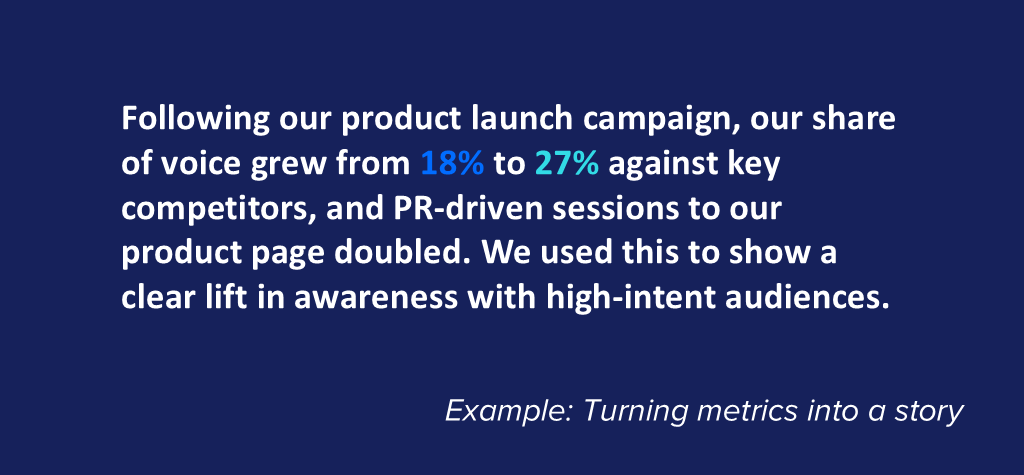
Example: Turning metrics into a story
When reporting on PR impact, here’s where your storytelling skills come in. Rather than listing metrics individually, connect them to a broader business narrative. For example:
Goal: Drive sales/revenue
What you’re trying to do: Turn awareness and interest into measurable commercial impact – more qualified opportunities, faster pipeline movement, and increased revenue influence.
If you only track one thing: Focus on a shared, sales-adjacent KPI with marketing or sales, such as PR-sourced demo requests, trial sign-ups, or sales meetings influenced by coverage.
Priority metric #1: PR-sourced and PR-influenced leads
- What it is: Prospects who first discovered or seriously considered you because of earned media or PR-driven content.
- How to get it: Add a “How did you hear about us?” field to lead forms, train sales and SDR teams to log PR mentions in the CRM, and tag opportunities touched by PR assets (articles, podcasts, bylines).
- How to read it: Even directional evidence (e.g., “saw you in X publication”) helps you show that PR is opening doors and warming up demand, not just generating buzz.
Priority metric #2: Conversion rate from PR-driven traffic
- What it is: The percentage of visitors who come from PR sources and complete a key action (demo request, trial, pricing inquiry, contact form).
- How to get it: Use tracking links (UTMs) in press releases and pitches where possible, then measure how that traffic behaves versus your site average.
- How to read it: If PR-driven visitors convert at or above the average rate, you can credibly argue that PR is attracting higher-intent audiences that are more likely to become customers.
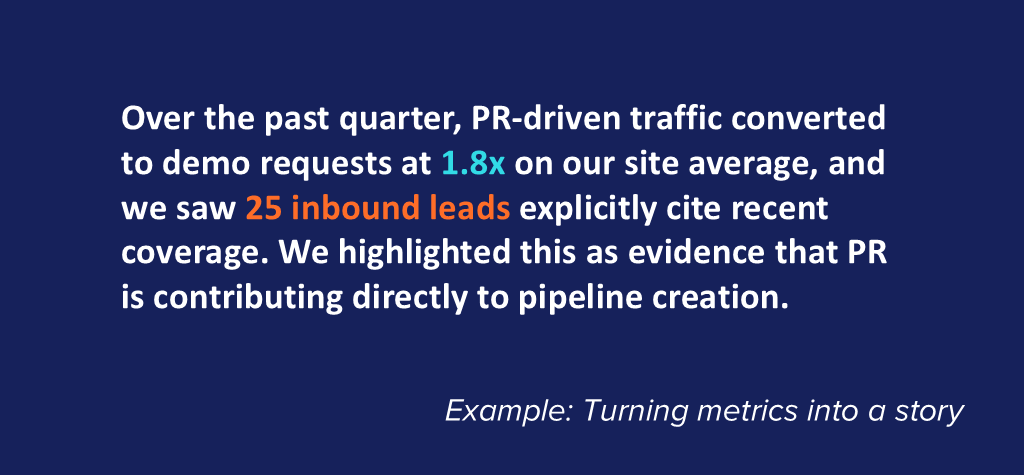
Example: Turning metrics into a story
Don't stop at the numbers. Show how your metrics connect to broader commercial outcomes and demonstrate the value communications delivers to the organization. For example:
Goal: Shape brand reputation
What you’re trying to do: Influence how people think and feel about your brand, not just how often they see it.
If you only track one thing: Look at sentiment over time across earned and social media.
Priority metric #1: Sentiment analysis
- What it is: The tone of coverage and mentions – positive, neutral, or negative.
- How to get it: Use automated sentiment analysis from your monitoring tool, then manually review high-impact stories for accuracy.
- How to read it: Look at trends over time and shifts during key campaigns or issues. An improvement in sentiment, even without more volume, is a meaningful reputation win.
Priority metric #2: Message pull-through
- What it is: How often your key messages appear in coverage.
- What it is: How often your key messages appear in coverage.
- How to read it: Track which messages land most consistently and in which outlets. Use this to refine your narratives, spokesperson training, and media targeting.
Priority metric #3: Quality of media coverage
- What it is: The depth, accuracy, and favorability of your stories – not all hits are equal.
- How to get it: Use a simple scoring rubric (for example, points for headline mentions, visuals, quotes, or share of voice within the article).
- How to read it: Combine your quality score with volume to show stakeholders you’re not just chasing clip counts but securing high-impact placements.
Priority metric #4: Influencer and expert endorsements
- What it is: Coverage or mentions by trusted industry voices, analysts, or creators.
- How to get it: Maintain a list of priority experts and track whenever they mention or collaborate with your brand.
- How to read it: Highlight endorsements as “reputation proof points,” especially in regulated or highly competitive spaces.
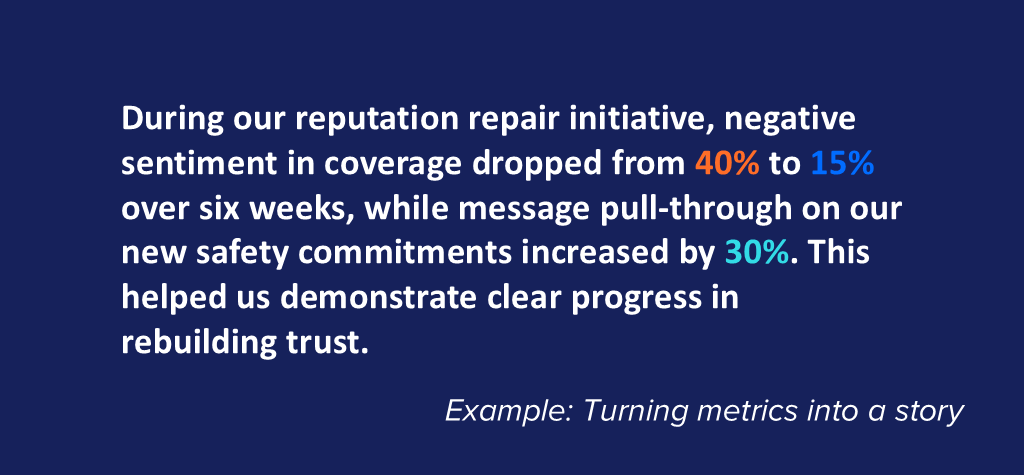
Example: Turning metrics into a story
When reporting on reputation or crisis communications, show how your metrics reflect meaningful progress over time. Connect changes in sentiment and message delivery to the wider objective of rebuilding trust. For example:
The bottom line
When it comes to PR measurement, we recommend tracking the things that matter most to your brand and telling a clear story with them. When you tie your metrics to business goals from the get-go, reporting stops feeling like a chore – it becomes one of your most powerful tools for demonstrating PR impact.
Pick the metrics that map to your current priorities, be consistent in how you collect and report them, and refine your approach as your goals evolve. Over time, a structured measurement practice won’t only prove PR’s value but also guide your decision-making and point you toward where to focus next.
In 2026, successful PR and comms teams don’t gather more data – they just home in on those numbers that matter (and can explain why).
See how all-in-one platform CisionOne can help you track PR metrics, proactively manage your reputation, and prove your efforts. Speak to one of our experts.