

Whether you were rooting for Spain or Argentina to win the 2026 World Cup, we always want you to score more earned media coverage. Major events like the World Cup give PR teams an opening to pitch sports and entertainment reporters, provided there’s a relevant news angle or link to the story.
But that window doesn’t have to be tied to a single tournament or season. The 2026 State of the Media Report offers year-round insights for gaining favor with journalists in these industries. So what are the secrets behind successful pitching?
Personalization matters in every media outreach effort, but the degree to which it matters – and what a reporter might consider a turn-off – can vary by industry. For the 2026 State of the Media Report, we wanted to get even more specific: We combined 782 responses from the entertainment industry and the sports industry to help you craft targeted pitches that get results.
Understand their biggest challenges
This one’s a can’t-miss step for your outreach strategy. Knowing journalists’ challenges gives you an opportunity to offer your support as they navigate them. Across the full survey, reporters named these as their industry’s biggest challenges:
- 50% – Accuracy, fact-checking, and combating misinformation
- 49% – Resource constraints (shrinking budgets, staff cuts, increased workload)
- 43% – Navigating the rise and impact of AI in journalism
- 42% – Adapting to evolving audience behavior and consumption trends
- 28% – Competition from nontraditional media and creators
- 27% – Commercial pressures (SEO, algorithm, sponsored content)
- 24% – Press freedom, censorship, and safety concerns
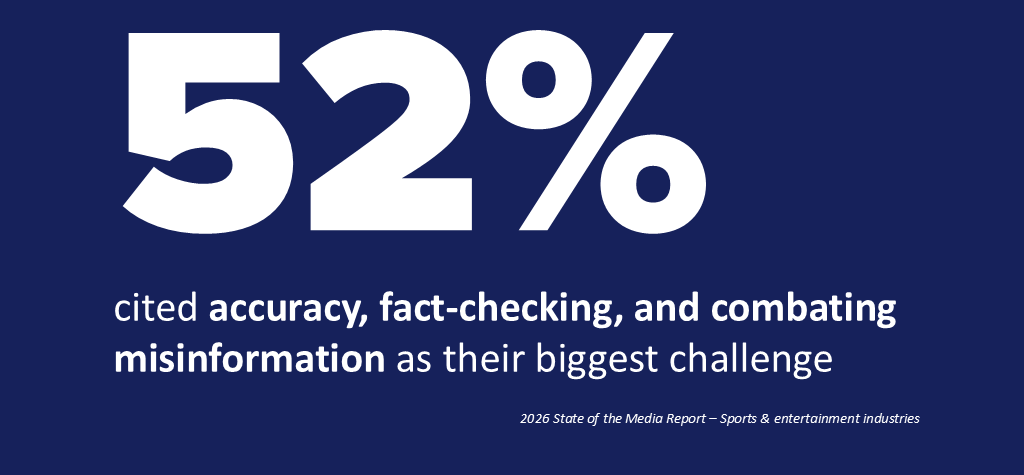
Sports and entertainment reporters ranked the same challenges somewhat differently:
- 52% – Accuracy, fact-checking, and combating misinformation
- 51% – Resource constraints (shrinking budgets, staff cuts, increased workload)
- 42% – Adapting to evolving audience behavior and consumption trends
- 40% – Navigating the rise and impact of AI in journalism
- 30% – Competition from nontraditional media and creators
- 27% – Press freedom, censorship, and safety concerns
- 27% – Commercial pressures (SEO, algorithm, sponsored content)
Two shifts stand out. Adapting to audience behavior moves up to the third spot for the sports and entertainment niche, ahead of AI's impact, which ranks fourth overall. Press freedom also climbs slightly, landing sixth here versus seventh in the overall results.
PR takeaway: Accuracy in every pitch is a non-negotiable, so always make sure to double-check your sources. Moreover, reporters in this space are more concerned about press freedom, so keep in mind their concerns about the safety and integrity of their profession.
How do they use social media?
Before you start crafting your pitch, put your detective’s cap on and see how journalists use social media. Social platforms shape how reporters find stories, build their audience, and decide who's worth engaging with, which makes any insight a useful signal for you.
Knowing which platforms sports and entertainment reporters actually use – and what they use them for – makes it easier to research the right contacts and understand what kind of content resonates with their audience.
Sports and entertainment reporters use social media for largely the same reasons as reporters overall, and in nearly the same proportions: publishing or promoting content (55% vs. 54% overall), crowdsourcing information for stories (38% vs. 37%), interacting with their audience (38% vs. 37%), picking up on trending topics (30% vs. 28%) and staying on top of breaking news (25% for both).
The real difference shows up in which platforms they favor. Across all reporters, the most-used platforms are LinkedIn (62%), Instagram (54%), Facebook (53%), X (37%), YouTube (35%) and WhatsApp (29%). But sports and entertainment reporters break from that pattern:
- 70% – Instagram
- 64% – Facebook
- 55% – LinkedIn
- 42% – YouTube
- 40% – X (Twitter)
- 35% – WhatsApp
- 24% – TikTok
- 15% – Threads
- 15% – Reddit
LinkedIn drops out of the top spot for these industries, reflecting a less formal beat where athletes, entertainers, teams, and studios maintain a heavy presence on Instagram and Facebook. YouTube also outranks X here, and Threads sees more use than it does among reporters overall.
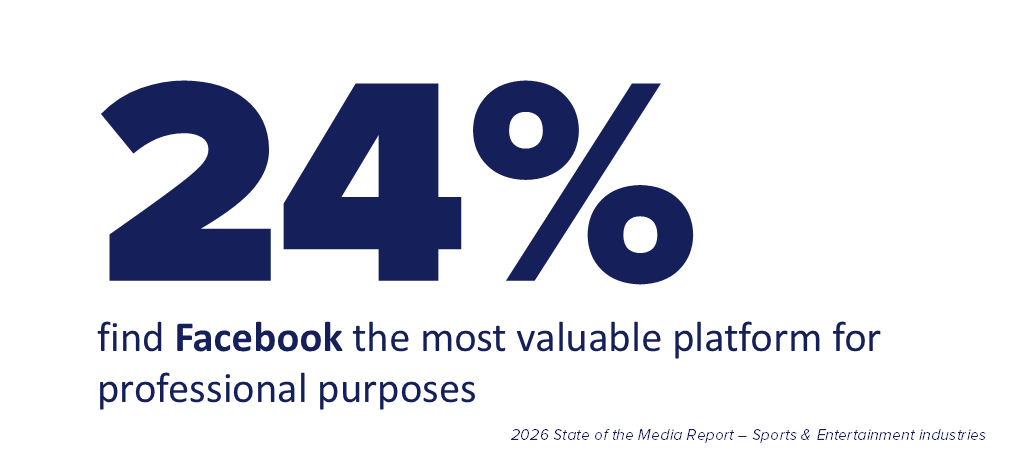
When asked which single platform they find most valuable for professional purposes, sports and entertainment reporters pointed to Facebook (24%), Instagram (22%), and LinkedIn (19%).
You can (and should) use social media to research the journalists you want to pitch, but that doesn’t mean you should reach out on those platforms. Like reporters overall, 98% of sports and entertainment reporters still overwhelmingly prefer to receive pitches by email.
PR takeaway: Think about the kind of content and story elements that would translate well to the platforms these reporters and their audiences actually use.
What they want from your pitch
Probably the question you’ve been waiting for: What do journalists actually want from your outreach? Overall, these elements make reporters more likely to consider a pitch: relevant to their beat, audience, or coverage area (79%), a timely or newsworthy angle (35%), credible data or research (33%), an exclusive or unique opportunity (27%), and personalization (24%). But sports and entertainment reporters weighted these somewhat differently:
- 78% – Relevant to my beat, audience, or coverage area
- 32% – A timely or newsworthy angle
- 29% – An exclusive or unique opportunity (interview, event/location access, product test, etc.)
- 27% – Personalization to me as a journalist
- 27% – Credible data or research
Relevance still matters most, but exclusivity and personalization both climb in importance relative to the overall results, while credible data slips slightly. For journalists in these industries, a pitch that feels tailored and offers something no one else has may outperform one leaning on data alone.
Using AI to craft a pitch? Think twice
Accuracy, personalization, and a human tone carry weight, and that shows in how sports and entertainment reporters feel about PR pros using AI to write pitches. Across all reporters, 27% are somewhat opposed to AI-assisted pitches and 26% are strongly opposed.
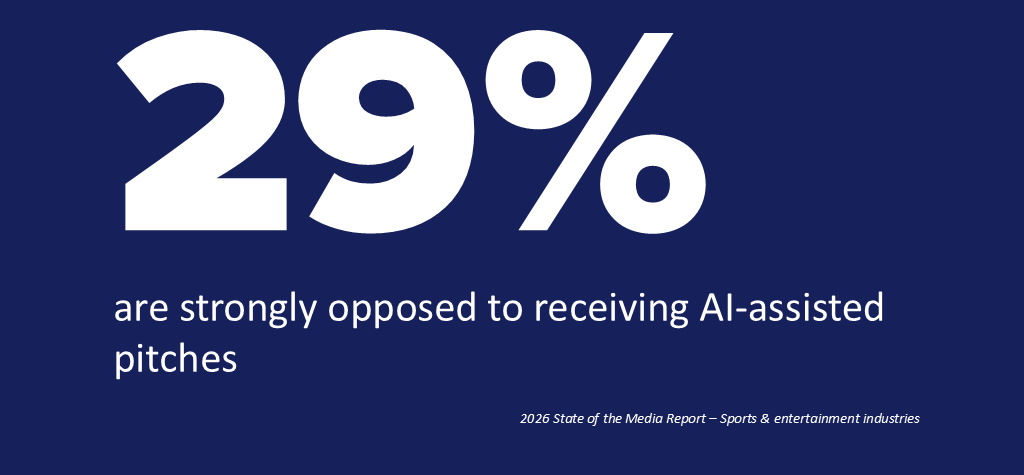
Sports and entertainment reporters are firmer still:
- 29% – Strongly opposed
- 29% – Somewhat opposed
- 23% – Neutral
- 17% – Somewhat in favor
- 2% – Strongly in favor
Roughly 6 in 10 sports and entertainment reporters oppose AI use in pitches, compared with about half of reporters overall.
PR takeaway: A pitch that reads as templated or AI-generated is a real risk to your chances of securing earned media. You can use AI tools for drafting pitches, but make sure you take the time to edit, personalize, and add your personal touch.
What not to do when pitching sports & entertainment reporters
The top reasons reporters reject a pitch track closely with the overall results: not relevant to their audience or coverage area (80% vs. 82% overall), too promotional or sales-focused (48% vs. 53%), no clear news angle or point of view (32% vs. 34%), and too generic or mass-email feel (26% vs. 27%).
But reporters can go further than ignoring a pitch – some will straight up block PR professionals. Why? Overall, the top reasons reporters cited for putting a PR contact on their “don’t call” list were spamming them with irrelevant pitches (72%), pitches that sound like marketing brochures (49%), providing inaccurate or unsourced information (405), and following up repeatedly (38%). Sports and entertainment reporters gave largely the same reasons:
- 68% – Spamming me with irrelevant pitches
- 47% – Pitches that sound like marketing brochures
- 41% – Providing inaccurate information
- 38% – Following up with me repeatedly
More than 1 in 3 reporters will block a PR contact who follows up repeatedly. Nearly 2 in 3 (63%) prefer a single follow-up at most, and more than 1 in 4 (28%) would rather not be followed up with at all.
PR takeaway: Knowing when – or if – to follow up matters as much as the pitch itself. Being too pushy might compromise a future relationship with the journalist, but being respectful of their boundaries means you might still have a chance of getting a response when you pitch them next. If they don’t get back to you after one follow-up, then it’s time to move on.
How to connect with pitching sports & entertainment reporters
First impressions matter, especially in the media-PR relationship. So, how can you approach journalists and get on their good side?
Across all industries, reporters said they'd welcome the following approaches from you: an introduction over email, telling them why you want to connect (84%), pitching them a new, relevant story idea (36%), inviting them to an industry or networking event (34%), connecting with them on social media (18%), contacting them directly on the phone (17%), and sending a digital or physical press kit (16%). Sports and entertainment reporters responded similarly, with one notable exception:
- 85% – Introduce yourself over email and tell me why you want to connect
- 35% – Pitch me a new, relevant story idea
- 34% – Invite me to an industry or networking event
- 21% – Send a digital or physical press kit
- 16% – Contact me directly on the phone
- 16% – Connect with me on social media
The top three approaches track closely with the overall results, but the press kit jumps from sixth place overall to fourth here. A well-put-together press kit carries more weight with sports and entertainment reporters than it does with reporters as a whole, making it worth the extra effort.
PR takeaway: A strong introduction starts with an email, but adding a new story idea or sending an invitation to a relevant event will give journalists a reason to remember you, not just your pitch.
How to identify the right reporters for a sports & entertainment pitch
A media database like CisionOne Outreach can help surface the outlets and reporters covering sports and entertainment topics and trends relevant to you. Beyond identifying the right contacts, these tools can also surface reporter-level intel – other outlets they write for, recent coverage, additional beats, and social media activity – that supports the kind of personalization they value so much.
Search intelligence tools, such as Trajaan, can also help surface trends relevant to the industry, giving you another way to time pitches around what's already resonating with sports and entertainment audiences.
Want to see how these tools can help you with your outreach strategy? Check out CisionOne's suite of solutions by requesting a demo.
This is only a piece of the puzzle. To explore our full journalists survey results, download the 2026 State of the Media Report.